7 ways to reduce restaurant labour costs
Seven practical ways to reduce restaurant labour costs. Match staffing to demand, review hours worked and test one change in your next schedule.
Two extra people on the floor may be exactly what you need on a fully booked Saturday. On a quiet Tuesday, the problem may be that everyone starts at the same time, even though guests don’t arrive until an hour later.
Start with a shift that regularly takes more staff hours than planned. Find out why before cutting cover. A late close, an uneven lunch rush and a missed clock-out each call for a different response.
1. Match staffing to when guests actually arrive
Compare a few similar shifts. When did orders come in? When did the queue build? What needed to be ready before the first guests arrived?
If the lunch rush starts at 11:45, the whole team may not need to start together. One person can handle opening and the next can join when demand picks up. Try moving one start time and track both staff hours and waiting times. If the queue grows or prep falls behind, adjust the plan.
2. Look for schedule changes that keep happening
You can rarely plan for someone calling in sick. But if you need extra cover for the same evening shift every Friday, that tells you something about the next schedule.
Review the changes from the past few weeks. Note which ones recur and why. You may need an extra person for the dinner rush, while the regular team can cover the rest of the evening. Have the person in charge approve changes in one place where everyone can see the current schedule.
3. Compare scheduled hours with hours worked while the shift is fresh
Five people work ten minutes longer than planned, five days a week. That adds up to 4 hours and 10 minutes beyond the schedule in one week.
There may be a good reason. If guests often stay late and closing takes half an hour, the scheduled finish may be too early. If the same prep tasks are left to the closing team every night, try moving them to a quieter part of the shift.
Check that the reported time is accurate first. Investigate missed clock-outs. Never reduce time that was actually worked to make it fit the budget.
4. Assign closing tasks clearly
Look at what the team does in the last 30 minutes. Who closes the till? Who handles the dishes? What could be done earlier without disrupting service?
Try a simple list with an owner for each task. If two people regularly wait for one job to finish, find out what’s holding it up. If everyone is already busy throughout, schedule a more realistic finishing time.
5. Account for extra hours when you build the schedule
Review which shifts often run late and which attract pay premiums. If someone regularly stays after closing, compare the cost and workload of scheduling a later finish with those of redistributing tasks during the evening.
Use the terms that apply to your team when estimating unsocial-hours premiums and extra hours. When changing schedules in Sweden, also check working hours, rest and breaks. Sweden’s Working Hours Act covers these matters, and collective agreements can affect which provisions apply. See the Swedish Work Environment Authority’s guidance (in Swedish).
6. Measure how long payroll preparation takes
During one pay period, note how often someone copies hours, chases approvals or checks which version of a timesheet is current. Start with the step that takes the most time.
In Simflexity, approved hours can feed into payroll. A manager still needs to investigate a missed clock-out, for example, but doesn’t have to enter the approved time again. Track how much admin time you actually save. Report that separately from changes in staffing costs.
7. Account for the cost of training new staff
If you often call people in at short notice, find out why. Are shifts hard to plan around? Is there only one person who knows how to close? Is training so brief that experienced staff have to stop their own work to help?
Try one change that makes the team less dependent on any one person. Train another team member on closing, for example, and track how often you need last-minute cover the following month. Include the time spent on training when you review the result.
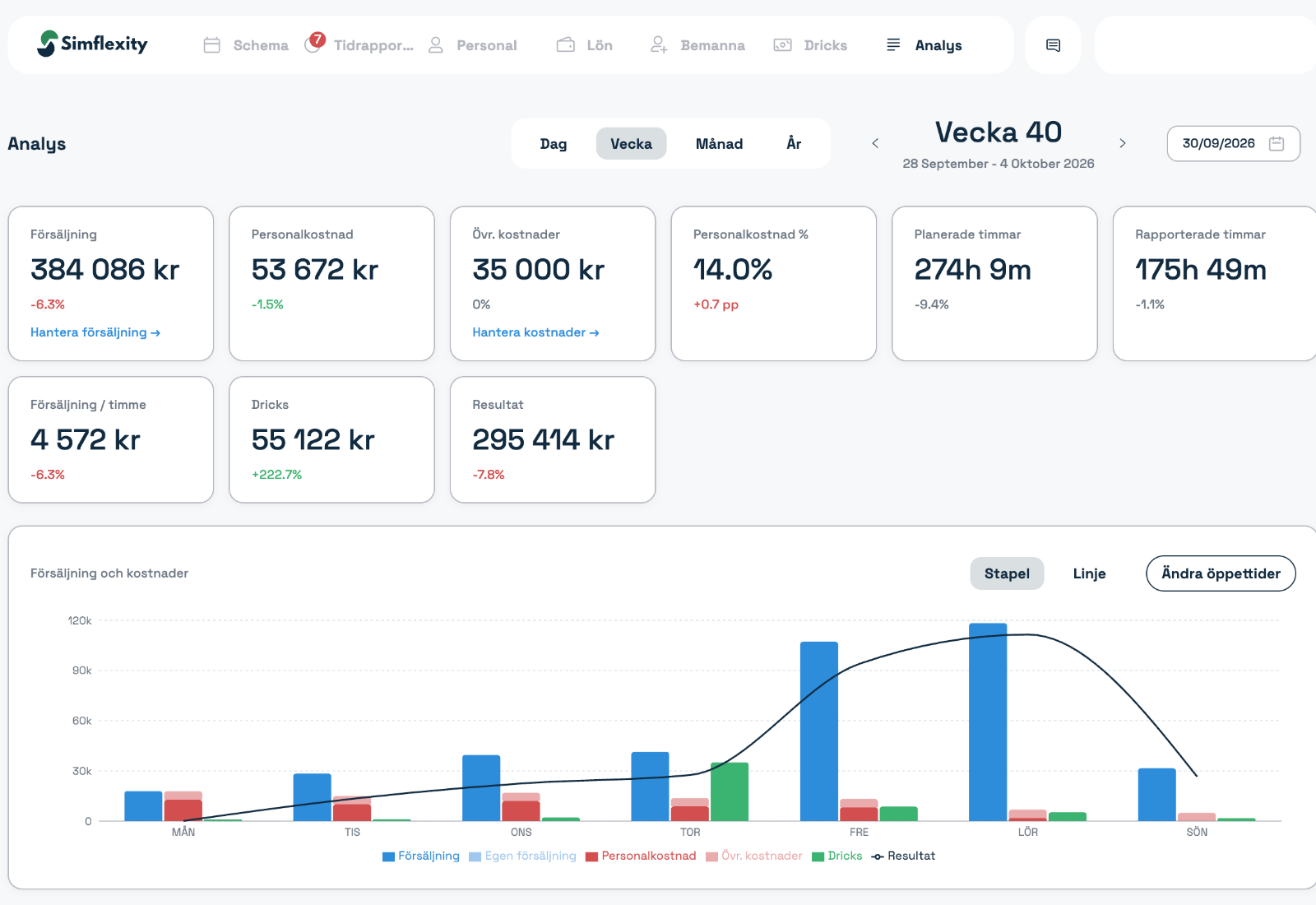
Start with one shift next week
Pick a recurring shift, such as Friday lunch. Record sales, scheduled staff hours and verified hours worked. Include a measure of service, such as how long guests waited when the queue was at its longest.
Change one thing before the next comparable shift. If staff hours drop but waiting times rise, weigh that trade-off. If you can deliver the same service with fewer staff hours or less duplicate work, you’ve found a change to keep.
Want to work out what the shift costs first? Read our guide to calculating labour costs per shift.
Want to see how to review scheduled and reported hours in Simflexity? Bring a recurring shift to a demo and we’ll walk through it with you.